On inherited dreams, inner authority and the courage to discover what is truly yours
By Marlyne Lili Lack

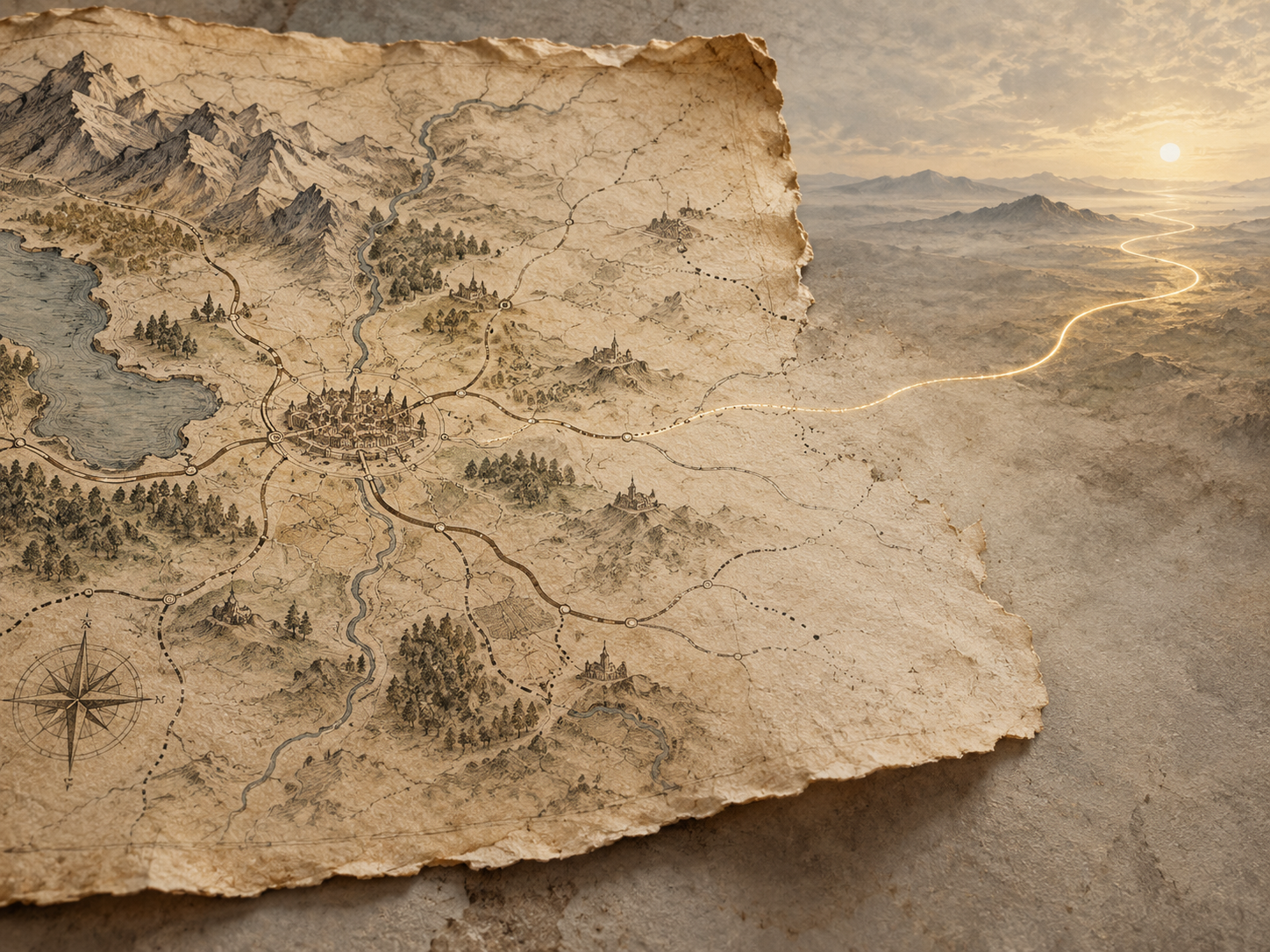
Some of the most powerful maps we follow are the ones we never consciously agreed to.
There are dreams we choose, and then there are dreams we inherit so quietly that for years we cannot tell the difference.
A good education. A respectable career. A certain kind of relationship. Financial security. The right title. The right home. A life that makes sense when someone asks what you are doing with yourself. None of these things is inherently wrong. The more interesting question is whether they are yours.
Long before most of us know how to ask what we truly desire, we are already learning what a good life is supposed to look like. We absorb ideas about success, ambition, spirituality, money, love, responsibility and possibility through our families, our schools, our cultures, our communities and the environments that taught us how to belong.
We learn what is respectable and what is reckless. What is realistic and what is ridiculous. What someone like us should expect from life. How much we are allowed to want. Which dreams will make people proud, and which ones may make a room go quiet.
Then we grow older and call many of those inherited boundaries our own thinking.
It is possible to become extraordinarily disciplined in pursuit of a life you never consciously chose. It is possible to become productive, admired and outwardly successful while something within you remains strangely absent from that success. The goals can look completely reasonable and still have been selected long before you learned to question who selected them. The research source that inspired part of this inquiry describes precisely this phenomenon: people moving toward goals they did not consciously choose and later discovering that they do not care deeply about the direction they are pursuing.
It is possible to become very good at living someone else’s life without realizing that many of the goals guiding you were inherited rather than consciously chosen.
Sometimes the first sign is not catastrophe. It is a whisper.
Did I actually choose this?
I think that question can mark the beginning of something sacred.

The lives we learn to want
Henry David Thoreau wrote:
“If a man does not keep pace with his companions, perhaps it is because he hears a different drummer.”
— Henry David Thoreau, Walden
I have always been interested in that gap between the rhythm a person hears within and the rhythm a culture expects them to follow.
What happens when the two no longer match?
Perhaps you are moving through life at a pace that once made perfect sense, but something in you has begun hearing another rhythm. Perhaps the career you were proud to enter no longer contains the whole of you. Perhaps you reached the milestone and discovered that achievement did not answer the question you thought it would answer. Perhaps your idea of success has changed. Perhaps you do not even know what you want yet. You only know that something you once wanted no longer feels entirely true.
We often interpret this as confusion.
Sometimes it is.
But sometimes the confusion comes because the old map remains visible while the deeper direction has not yet become language.
This is one of the places where I believe we must be very careful not to rush.
The world is quick to offer another answer. Another plan. Another method. Another identity. Another person who will tell you exactly what to do next.
But perhaps the first task is not to replace one map with another.
Perhaps it is to become curious about who has been holding the map.
Who decided what was realistic for you?
We usually imagine our future from the world we have already seen.
What our parents know. What our teachers understand. What people around us consider achievable. What our profession rewards. What our communities recognize as success. What the internet repeats often enough that it begins to feel inevitable.
Then we call those boundaries reality.
One of the ideas that informed this essay is that people often water down a goal until it fits the life their family, teachers or peers already expected them to have.
That interests me deeply because it raises a question I think we rarely ask:
What if some of what you call realistic is simply familiar?
What if the edge of your imagination has been drawn by what the people around you have already seen?
This does not mean that every improbable desire is Divine guidance. It does not mean practical reality should be ignored. Discernment matters. Responsibility matters. Money matters. Capacity matters. Consequences matter.
But the fact that reality matters does not mean your inherited definition of reality is complete.
Who taught you where your life was supposed to stop?
Who taught you how much was enough to want?
Which desire did you dismiss before you ever investigated it?
Which part of your dream did you make smaller because you did not yet know how to explain it?
And if no one around you needed to approve of the answer, what would you admit that you actually want?
The quiet ways we edit ourselves
Most of us do not abandon ourselves dramatically.
We do it through translation.
Someone asks about the future and we give them the reasonable version. We remove the part that feels too large, too spiritual, too unconventional, too creative or too difficult to defend. We take something alive and make it socially digestible.
Over time, we become skilled translators of ourselves.
We know what language will make people comfortable. We know how to make the dream sound practical. We know which parts of ourselves will be understood and which ones are easier to leave unmentioned.
Eventually, the translated version can become so familiar that we forget there was an original language.
I wonder how many people are living lives that are not exactly false, but edited.
The job may genuinely suit part of you. The relationship may contain real love. The business may have emerged from a real gift. The path may have been right for a season.
Yet something essential may have been removed in the process of making the life understandable.
This is where my inquiry into Original Essence becomes more than a poetic idea.
Before we ask what to build, create, pursue or become, I want to know:
What remains when you stop editing yourself into recognizability?
Before the goal, there is an Origin
We live in a culture fascinated by goals.
Choose the goal. Write it down. Build the plan. Become disciplined. Optimize the process.
But I think another question belongs before all of those.
From where in you is the goal being chosen?
Two people can pursue exactly the same external thing from completely different inner origins.
One may desire visibility because something true wants expression. Another may desire visibility because being unseen once felt unbearable. One may create wealth because prosperity feels expansive, generative and life-giving. Another may use wealth as evidence that they are finally worthy. One may build a business because a contribution genuinely wants form. Another may build one because the identity of entrepreneur has become a socially acceptable way to prove something.
The external form cannot tell us the entire story.
The Origin matters.
There is a useful idea I have been sitting with: a goal can function as more than a destination. It can become a point of view, a lens that begins determining which information, opportunities and possibilities we notice.
If that is true, then the question of Origin becomes even more important.
Because before your goal begins filtering the world, something has already filtered which goal you chose.
Was it fear?
Comparison?
Belonging?
Conditioning?
A need for approval?
An inherited definition of success?
Or is there a quieter movement beneath all of that, something that continues returning even after the noise settles?
This is not a question I think another person can answer entirely for you.
Trusting yourself is not the same as believing every thought
Ralph Waldo Emerson wrote:
“Trust thyself: every heart vibrates to that iron string.”
— Ralph Waldo Emerson, Self-Reliance
There is something beautiful in that invitation, but I would add an important distinction from my own work.
Self-trust is not the same as assuming that everything arising within us is truth.
Fear can speak from within us. Conditioning can speak from within us. Trauma can speak. Desire can speak. Ego can speak. Intuition can speak. The soul can speak. Sometimes several of them speak at once.
This is why I am much more interested in discernment than in simplistic instructions to “just trust yourself.”
Discernment is a relationship.
It is developed by listening long enough to recognize your own patterns. By noticing the difference between urgency and knowing. By allowing your body, mind, spirit, intuition, experience and practical reality to enter the same conversation. By becoming willing to question yourself without automatically abandoning yourself.
Inner authority is not infallibility.
Spiritual sovereignty is not certainty.
It is the growing capacity to remain present in your own choosing.
Borrowed maps do not disappear when we become spiritual
The spiritual path can introduce a very sophisticated version of the same problem.
We begin questioning conventional definitions of success and discover spirituality, metaphysics, ancient traditions, astrology, Human Design, teachers, coaches, healing systems, philosophies and methods of self-understanding.
Many of these can be profoundly valuable.
I am someone who studies.
I believe in learning. I believe there are teachers whose wisdom can change the course of our lives. I believe traditions can hold knowledge that an individual could never generate alone. I believe maps can reveal terrain we did not know existed.
But the relationship matters.
J. Krishnamurti made an extraordinary declaration in 1929:
“Truth is a pathless land.”
— J. Krishnamurti
He was challenging the idea that truth could be possessed, organized or delivered through one prescribed path. I do not take that to mean we should reject every tradition or refuse guidance. What interests me is the warning contained inside it.
A map can help you find your way.
A map can also become another cage.
A spiritual system can help you recognize yourself. It can also become a new identity you learn to perform. A teacher can awaken something in you. They can also become so authoritative that you forget how to encounter your own knowing. A framework can reveal a pattern. It can also tempt you to interpret every experience through the framework rather than through your living relationship with life.
It is entirely possible to leave society’s borrowed maps and inherit spiritual ones instead.
We stop asking our family who we should be and begin asking a chart.
We stop needing approval from one authority and quietly install another.
That is not the spiritual sovereignty I am interested in.
I am interested in a relationship with wisdom that makes you more capable of knowing, not less.
What is your life devoted to?
Our lives reveal our devotion long before our words do.
You may say you value freedom while organizing your decisions around approval. You may say you value expression while organizing your life around avoiding judgment. You may say you want to hear your soul while filling every quiet space with someone else’s voice. You may say you want a different life while devoting most of your energy to preserving the identity that keeps the old one intact.
This is not an accusation.
I think these contradictions are deeply human.
Sometimes the old devotion kept us safe.
Approval helped us belong. Predictability gave us stability. Achievement created identity. Control helped us survive uncertainty. Being understandable protected us from rejection.
I do not think the answer is to shame those adaptations.
But at some point, we may need to ask whether what protected a former season should continue governing the next one.
What is your life actually organized around now?
What does your calendar reveal?
What does your attention reveal?
What repeatedly receives your energy?
What are you protecting?
What are you postponing?
What becomes possible only if you remain exactly who you have been?
And perhaps the deepest question:
What are you devoted to without realizing you have made it sacred?
Perhaps you are not lost. Perhaps the old map ended.
Joseph Campbell wrote:
“You enter the forest at the darkest point, where there is no path.”
— Joseph Campbell, Pathways to Bliss
I love this because it gives another meaning to the seasons in which we cannot see the way forward.
We tend to assume that if there is no visible path, something has gone wrong.
But perhaps sometimes the absence of a path is precisely the point.
Perhaps you have arrived somewhere imitation can no longer take you.
The old career map ends.
The old identity map ends.
The spiritual map that explained everything suddenly leaves questions unanswered.
The version of success you inherited stops motivating you.
The person you believed you should become no longer feels large enough for what is moving within you.
We call this being lost because the familiar coordinates have disappeared.
But what if the unknown is not always an error?
What if some parts of a life can only be discovered when there is no existing road to follow?
This does not mean walking recklessly. Campbell himself framed the path as one that requires discovering what is genuinely one’s own rather than simply following someone else’s established way.
There is a difference between wandering without consciousness and entering the unknown with devotion.
One is disconnection.
The other may be initiation.
The return is not another borrowed map
This is the distinction I want to protect in my own work.
Original Essence Flow™ is not meant to become another authority that tells you who you must be.
I am not interested in giving you a more beautiful box.
“The pathway back to your Original Essence is, for me, a sacred devotion to your Original Breath, a return to your Original Spirit, your truth, and ultimately to what I call the Original Essence of all Essences.”
— Marlyne Lili Lack, creator of Original Essence Flow™
Not so that you become more impressive.
Not so that you can collect another spiritual identity.
But so that something uniquely yours can begin to emerge from a deeper Origin.
Something only you can create.
Something only you can live.
Something that could not have come into form through imitation because it required the meeting of Divine Origin with this particular soul, body, history, intelligence, imagination and life.
That is why the return cannot only be intellectual.
It is relational.
A relationship with the Divine. A relationship with your own inner intelligence. A relationship with your body and your desires. A relationship with your capacity to discern. A relationship with your gifts and your contradictions. A relationship with the seasons through which your Essence asks to move.
And from that place, the questions begin changing.
Instead of asking What am I supposed to become?, we may begin asking What is already asking to become lived through me?
Instead of endlessly searching for the correct map, perhaps we ask What can these maps teach me while I learn the movement of my own soul?
Instead of asking whether a dream is realistic according to everything we already know, perhaps we become curious about whose reality we have been using to decide what is possible.
And instead of creating a life designed primarily to be understandable, perhaps we begin asking:
What is true enough that I am willing to give it form?
That is the inquiry inside Beyond the Borrowed Maps™.
It is not a rejection of wisdom. It is not a rejection of teachers, traditions, strategy, knowledge or support. And it certainly is not an insistence that we should walk alone.
It is an invitation to remember that none of those things were ever meant to replace your participation in your own life.
“The map was never meant to replace the one who is walking.”
— Marlyne Lili Lack
Perhaps that is spiritual sovereignty.
Not having all the answers , because that’s how inner trust is built.
And becoming rooted enough in your relationship with the Divine, your Original Essence and your own discernment that you can receive wisdom without disappearing inside it.
And from there, walk.
Continue the inquiry
If you are beginning to question the goals, identities and definitions of success you inherited, continue with What Is Original Essence?
If you feel ready to enter a sacred space where you can explore your Original Essence, learn its natural flow, rhythm, season and expression, and begin giving what is uniquely yours form in your life and work, The Original Essence Flow™ Apprenticeship is where this inquiry becomes a lived practice.